
Lycurgus Cup
The Lycurgus Cup represents one of the outstanding achievements of the ancient glass industry. This late Roman cut glass vessel is extraordinary in several respects, firstly inthe method of fabrication and the exceptional workmanship involved and secondly in terms of the unusual optical effects displayed by the glass.
The Lycurgus Cup is one of a class of Roman vessels known as cage cups or diatreta, where the decoration is in openwork which stands proud from the body of the vessel, to which it is linked by shanks or bridges Typically these openwork “cages” comprise a lattice of linked circles, but a small number have figurative designs, although none of these is as elaborate or as well preserved as the Lycurgus Cup. Cage cups are generally dated to the fourth century A.D. and have been found across the Roman Empire, but the number recovered is small, and probably only in the region of 50-100 examples are known .
They are among the most technically sophisticated glass objects produced before the modern era.
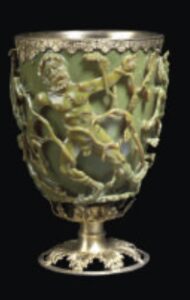
The Lycurgus Cup in reflected light.
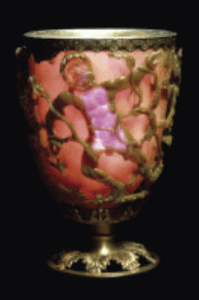
The Lycurgus Cup with transmitted light.
The dichroic properties of the Lycurgus Cup are simulated in Zemax.
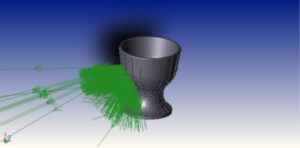
The simulation of Reflected light.
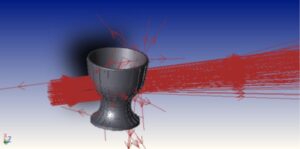
The simulation of Transmitted light.
The openwork decoration of the Lycurgus Cup comprises a mythological frieze depicting the legend of King Lycurgus from the sixth book of Homer’s Iliad. The figures, carved in deep relief, show the triumph of Dionysus over Lycurgus.
However it is not only the cut-work design of the Cup that shows the high levels of skill involved in its production. The glass of the cup is dichroic; in direct light it resembles jade with an opaque greenish-yellow tone, but when light shines through the glass (transmitted light) it turns to a translucent ruby colour.
Analytical transmission electron microscopy
has revealed the presence of minute particles of metal, typically 50-100 nm in diameter. X-ray analysis showed that these nanoparticles are silver-gold alloy, with a ratio of silver to gold of about 7:3, containing in addition about 10% copper.
The identification of silver-gold alloy particles confirms the earlier inference that the dichroic effect is caused by colloidal metal. In addition to these metallic particles, the glass was shown to contain numerous small particles (15-100nm) that were shown to be particles of sodium chloride, the chlorine probably derived from the mineral salts
used to supply the alkali during the glass manufacture .
Of interest is the high gold to silver ratio of the alloy particles in the glass (c. 3:7) relative to the gold:silver (Au:Ag) ratio in the glass as a whole (c. 1:7). This is a reflection of the relative reduction potentials of Ag+ and Au+ and indicates that a substantial proportion of the silver remained dissolved in the silicate matrix after precipitation of the alloy particles.
Recent work indicates that gold dissolves in glass in the monovalent form. The reduction
of previously dissolved silver and gold, during heat-treatment of the glass, will have caused the fine dispersion of silver-gold nanoparticles responsible for the colour. A key agent likely to
have been involved in the redox reaction that reduced the silver and gold is the polyvalent element antimony, which is present in the glass at around 0.3%. Antimony was commonly
added to glass in the Roman period, as both an oxidising agent (decolourant) and as an opacifier.
